
5 Star Google Reviews
DVSA Approved MOT Centre
Castrol Service Partner
Trust My Garage Approved
EV & Hybrid Specialists
Last updated: July 2026
Whether you are heading to the coast, travelling through the Scottish Highlands, or driving across Europe, preparing your car properly can help prevent a breakdown from becoming an expensive and stressful part of your holiday.
Long motorway journeys, hot weather, additional passengers, and a boot full of luggage place greater demands on your tyres, brakes, battery, cooling system, and suspension. A few simple checks before you leave, and a professional inspection where needed, can make your journey safer and more comfortable.
It is also important to remember that having a valid MOT does not automatically mean that a vehicle is safe on the day you travel. Drivers remain responsible for making sure their vehicle is roadworthy whenever it is used.
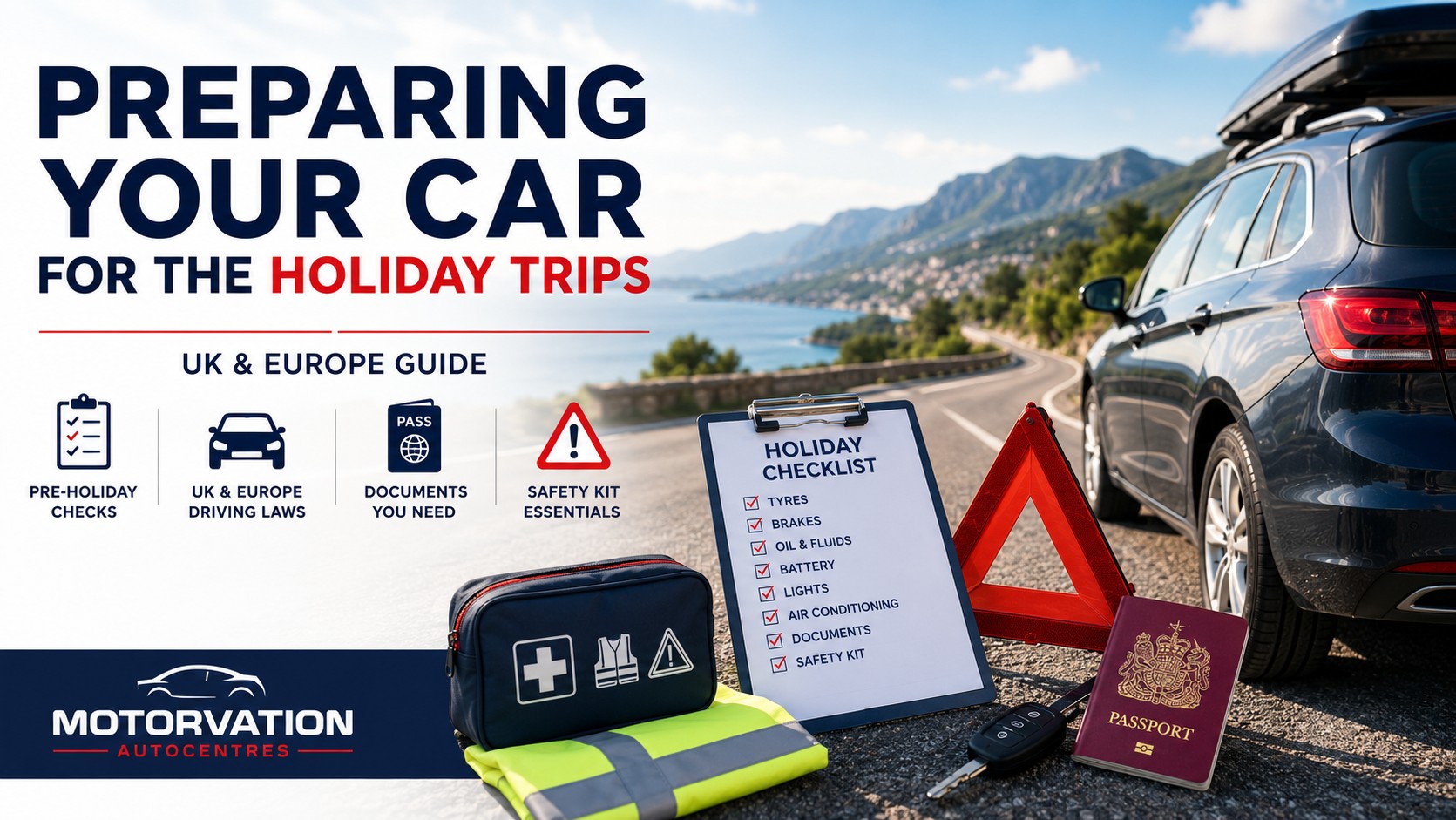
Here is the Motorvation Northampton complete holiday car checklist for driving in the UK or Europe.
Tyres are one of the most important parts of any pre-holiday car check. They affect braking, steering, fuel economy, and the vehicle’s ability to remain stable in wet or emergency conditions.
Check all four tyres, and the spare tyre where fitted, for:
The UK legal minimum tread depth for most car tyres is 1.6mm across the central three-quarters of the tyre and around its complete circumference. However, a tyre that is only just above the legal minimum may offer significantly less confidence during heavy rain, so consider replacing tyres that are close to the limit before a long holiday journey.
Check tyre pressures when the tyres are cold. If the vehicle will be carrying several passengers, heavy luggage, a roof box, or bicycles, use the manufacturer’s recommended fully loaded tyre pressures. These are normally shown in the handbook, inside the fuel flap or on the driver’s door aperture. Incorrect tyre pressures can adversely affect braking, steering, tyre life, and fuel consumption.
Do not forget to check that you have your locking wheel nut key. Keep it somewhere accessible rather than underneath a fully loaded boot.
Long journeys and high summer temperatures can expose problems within the engine and cooling system.
Before travelling, check:
Always use the correct oil, coolant and screen wash specified for your vehicle. If you regularly need to top up oil or coolant, have the vehicle inspected before your trip because this could indicate a leak or developing mechanical problem.
Government vehicle safety guidance recommends regularly checking oil, coolant, brake fluid, the battery, washer fluid and tyres rather than relying solely on dashboard warning lights.
Brakes can experience considerably more heat and wear during a holiday journey, especially when the vehicle is heavily loaded or travelling through steep and mountainous areas.
Arrange an inspection if you notice:
Brake pads that are already heavily worn before departure may not be suitable for several hundred additional miles. It is far better to identify this before leaving home than while travelling abroad.
Uneven tyre wear, steering vibration, or a vehicle that pulls to one side can indicate a wheel alignment, steering or suspension problem.
Correct wheel alignment can help:
If you have recently hit a pothole or kerb, or if the steering wheel is no longer straight when travelling on a level road, have the alignment checked before your holiday.
A weak battery may continue to start a car during everyday short journeys but fail after the vehicle has been parked at an airport, ferry terminal, hotel, or campsite.
Consider having the battery tested if:
The charging system should also be checked if there are concerns about the alternator or if the battery repeatedly loses charge.
Make sure all lights are clean and working, including:
Inspect the windscreen for chips or cracks, particularly within the driver’s field of vision. A small chip can spread during a long journey because of vibration or temperature changes.
Wiper blades should clear the glass smoothly without leaving smears. Top up the screen wash using a proper screen wash solution rather than plain water.
When taking a UK right-hand-drive vehicle into continental Europe, check whether the headlights have a built-in tourist or travel mode. If not, suitable beam converters may be needed to prevent the dipped headlights from dazzling oncoming traffic. GOV.UK specifically advises checking whether headlamp converters are required for your destination.
Effective air conditioning makes a long summer journey much more comfortable, but it also helps control humidity and clear condensation from the windows.
Before travelling, check that:
If the air is only slightly cool, the system may need testing rather than simply topping up. An air-conditioning service can identify low refrigerant, leaks, or pressure-related faults.
An air-conditioning sanitisation treatment can also help remove bacteria, mould and unpleasant odours from the ventilation system and vehicle interior.
Make sure the MOT will remain valid throughout your journey. If it is due shortly after your planned return, arranging it beforehand can remove the risk of delays or unexpected repairs immediately after your holiday.
Check the vehicle’s service schedule as well. A service may be due based on mileage even when the calendar date has not yet been reached.
Pay particular attention to time- or mileage-sensitive components such as:
A UK-registered vehicle taken abroad for less than 12 months must remain taxed, insured and covered by a valid MOT where one is required.
Many newer vehicles do not have a spare wheel. Instead, they have a compressor and tyre sealant.
Check that:
Tyre sealant cannot repair every puncture, particularly damage to a tyre’s sidewall. Suitable European breakdown cover is therefore strongly recommended when travelling abroad.
Do not overload the vehicle. Check the maximum permitted vehicle weight, roof load, and tow-bar nose weight where applicable.
Heavy items should be positioned low down and secured so they cannot move during sudden braking. Avoid placing loose objects above the height of the rear seats unless a suitable load guard is fitted.
Check roof boxes, roof bars, and bicycle carriers after the first few miles and again during the journey. Remember that a roof box may affect:
Even when staying within the UK, long journeys require preparation.
Before leaving, check your route for roadworks, planned closures, traffic delays and severe weather. Make sure you have breakdown cover details, a charged mobile phone and enough fuel or battery charge to reach a suitable stopping point.
A warning triangle can be used on some UK roads when it is safe to do so, but the Highway Code states that it must never be used on a motorway. Do not place yourself in danger by walking into moving traffic to position one.
Plan regular rest stops and do not continue driving if you feel tired. Sharing the driving can be particularly helpful on longer journeys.
For electric vehicles, identify several charging options rather than relying on one location. Allow for queues, faulty chargers, changes in weather and the additional energy used by motorway speeds, air conditioning, passengers and luggage.
Travelling abroad requires more than preparing the mechanical condition of the car. You must also carry the correct documents.
For most journeys in your own vehicle, take:
If the vehicle is leased, hired or does not belong to you, you may need a VE103 certificate or written authority confirming that you have permission to take it abroad. GOV.UK states that drivers taking their own car should carry the V5C and insurance certificate, while a VE103 is required for a UK-hired or leased vehicle.
Many popular European destinations accept a valid UK photocard driving licence for a normal holiday visit. However, the rules can differ if you have an older paper licence or are travelling outside the EU.
Check every country on your route, including countries you only intend to drive through. An International Driving Permit may be required for some destinations and must be obtained before leaving the UK.
A Green Card is generally not required when driving in the EU, Ireland, Iceland, Liechtenstein, Norway, Serbia or Switzerland, but you must still have valid insurance that covers every country on your route.
Check the territorial and time limits of your policy. Some policies provide only the minimum compulsory third-party cover abroad unless additional cover has been arranged.
A separate UK sticker is not normally required when the number plate displays the UK identifier together with the Union flag.
A UK sticker is required when the number plate has:
For Spain, Cyprus, and Malta, GOV.UK states that a separate UK sticker must be displayed regardless of what appears on the number plate. A UK sticker is not required when driving in Ireland. Old GB stickers should be removed or covered.
There is no single set of “European driving laws”. Each country sets its own speed limits, safety-equipment requirements, drink-driving limits, emission-zone rules, and winter tyre regulations. The European Commission advises drivers to check the rules for every individual country they will visit.
Most continental European countries drive on the right-hand side of the road.
Take particular care:
Place a reminder near the steering wheel if necessary.
European speed-limit signs generally show kilometres per hour rather than miles per hour. Most modern vehicles can display both units but make sure you know how to change the digital display before travelling.
Equipment that is optional or simply recommended in the UK may be compulsory elsewhere.
Depending on the countries being visited, you may need:
Keep reflective jackets inside the passenger compartment so they can be put on before anyone exits the vehicle. Carrying one for every occupant is sensible even where the law only specifies the driver.
Do not assume the limit is the same as England or Wales. Many European countries have lower limits, with even stricter limits for newly qualified or professional drivers.
The safest approach is not to drink any alcohol when you will be driving.
Handheld phone use is prohibited across the EU, but individual countries can impose additional restrictions.
For example, Spain prohibits the use of an earpiece while driving and requires a fully hands-free system. Simply pulling onto the side of the road may not be sufficient unless the vehicle is completely away from the carriageway.
Many European cities operate low-emission zones, but the system differs by country and city.
You may need:
Do not assume that a UK Clean Air Zone or ULEZ payment covers any European zone.
Some countries require winter tyres during particular dates. Others require them whenever wintry conditions are present.
Rules may also apply in designated mountain areas even when the rest of the country has no seasonal requirement. Check every country and region on your route if travelling during autumn, winter or early spring.
Many European motorways charge tolls. Some use toll booths, while others require an electronic vignette or permit purchased before using the road.
Check whether your route crosses toll roads, bridges, tunnels, or environmental zones before leaving. Do not rely entirely on your sat-nav to identify chargeable roads.
France requires vehicles to carry an approved warning triangle and a CE-marked high-visibility jacket. The jacket must be kept within reach, rather than buried underneath luggage in the boot. French official guidance also confirms that carrying a breathalyser is not compulsory, despite this still appearing on some older travel checklists.
Other points to check include:
Crit’Air restrictions apply in several French cities, and other areas may introduce temporary restrictions during periods of poor air quality. Order any required permit well before travelling and use the official French system rather than an unofficial reseller.
A separate UK sticker is required on UK-registered vehicles in Spain, even when the number plate already includes a UK identifier.
Spain also has low-emission zones known as Zonas de Bajas Emisiones, or ZBEs. Foreign vehicles cannot normally obtain a Spanish emissions sticker, but some cities require foreign vehicles to be registered online before entry. Barcelona is one example, so check the rules for each city on your route.
From January 2026, Spain introduced the connected V-16 warning beacon for Spanish-registered vehicles.
However, Spain’s Directorate-General for Traffic has clarified that foreign-registered vehicles travelling internationally in Spain comply with the rules if they carry and use traditional warning triangles, or another equivalent warning device permitted by the country in which the vehicle is registered. A UK visitor is therefore not automatically required to purchase a Spanish connected V-16 solely because they are driving into Spain.
Germany’s listed vehicle safety equipment includes:
Winter tyres are mandatory when wintry road conditions are present. Some German cities also operate environmental zones known as Umweltzonen, which may require an appropriate emissions sticker before entry.
Do not assume that every part of the autobahn has no speed limit. Many sections have permanent or temporary restrictions that must be followed.
Historic centres in many Italian towns and cities contain restricted areas known as Zona a Traffico Limitato, or ZTL zones.
The entrances are normally camera controlled. Entering without the correct permit can result in a fine, even when the sat-nav has directed you through the area. Check parking and access arrangements with your hotel before arriving, especially in cities such as Florence, Rome, Pisa and Milan.
Italy also has local congestion and emission restrictions, including charges in parts of Milan and vehicle restrictions within areas of Rome.
Electric and plug-in hybrid vehicles require many of the same mechanical checks as petrol and diesel vehicles.
Before travelling, check:
Motorway speeds, strong headwinds, hills, extreme temperatures, air conditioning, and additional luggage can all affect range.
A battery health check can provide useful information about the condition and available capacity of an older electric vehicle before a long journey.
A practical UK and European road-trip kit should include:
Check the exact legal equipment requirements for each country before travelling.
No. An MOT confirms that the vehicle met the required test standards at the time it was inspected. A vehicle can develop tyre, brake, battery, suspension or fluid-related problems afterwards, and the driver remains responsible for making sure it is roadworthy.
Ideally, arrange a service or inspection one or two weeks before departure. This gives the garage time to investigate problems and obtain any required parts.
For most cars, the legal minimum is 1.6mm across the central three-quarters of the tyre and around its complete circumference. Check for damage and uneven wear as well as tread depth.
You normally need a separate UK sticker if your number plate does not show the UK identifier with the Union flag. A separate sticker is required in Spain, Cyprus and Malta regardless of the identifier shown on the number plate. You do not need one for Ireland.
A Green Card is generally not required for EU countries, but you must have valid insurance covering every country on your route. Carry your insurance certificate and check the level and duration of overseas cover with your insurer.
Spain’s DGT has confirmed that foreign-registered vehicles travelling internationally in Spain comply if they carry or use warning triangles or an equivalent device permitted by their country of registration.
A professional inspection before your holiday can identify problems that may not be obvious during everyday driving.
At Motorvation Northampton, our experienced team can help check:
Try to arrange any inspection or service at least one or two weeks before travelling. This allows enough time to complete repairs or order parts without delaying your holiday.
Looking for holiday car checks in Northampton? Contact Motorvation Northampton before your journey to arrange servicing, tyres, wheel alignment, air-conditioning servicing or a vehicle inspection.
Call: 01604 765007
Book online: www.motorvation-northampton.co.uk